E Minor Scale on piano for Beginners (Piano Only)
When you start exploring emotional and expressive music, the E Minor Scale is one of the easiest and most useful scales to learn. It helps you understand how minor scales create a deeper and more emotional sound.
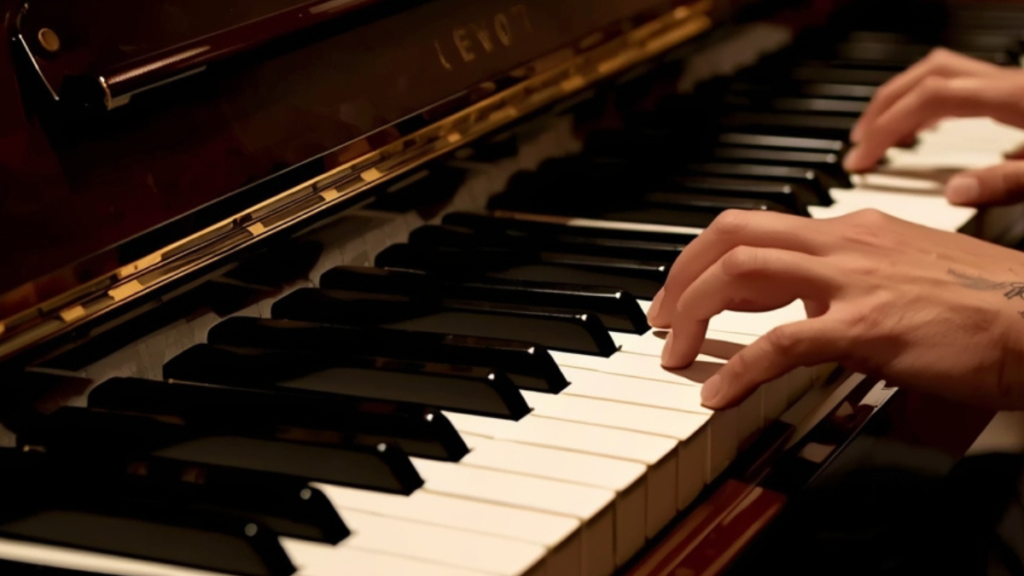
E Minor Scale on Piano – A Complete Guide
The E Minor scale is very beginner-friendly and is often one of the first minor scales pianists learn after major scales.
What Is the E Minor Scale?
The E Minor scale is a seven-note musical scale:
E – F# – G – A – B – C – D – E
It is called a minor scale because it produces a sad, soft, and emotional sound.
Why Learn the E Minor Scale on Piano?
- Easy to learn for beginners
- Improves emotional playing
- Builds a strong minor scale foundation
- Helps in playing real songs
- Enhances musical expression
E Minor Scale Notes Explained
E → F# → G → A → B → C → D → E
Pattern:
Whole – Half – Whole – Whole – Half – Whole – Whole
E Minor Scale on Piano Keys
- E (white key)
- F# (black key)
- G (white key)
- A (white key)
- B (white key)
- C (white key)
- D (white key)
Fingering Guide
Right Hand
1 – 2 – 3 – 1 – 2 – 3 – 4 – 5
Left Hand
5 – 4 – 3 – 2 – 1 – 3 – 2 – 1
How to Practice the E Minor Scale (Piano Tips)
- Start slowly and focus on accuracy
- Pay attention to F#
- Use a metronome (60 BPM)
- Practice hands separately first
- Gradually increase speed
Common Mistakes Beginners Make
- Missing the F# note
- Playing too fast, too soon
- Using incorrect fingering
- Poor hand positioning
How the E Minor Scale Helps You as a Pianist
- Improves emotional expression
- Builds finger control
- Strengthens understanding of minor scales
- Enhances overall musical skills
Piano Exercises (Beginner Level)
Exercise 1: Ascending & Descending
Play from low E to high E, then come back down slowly
Exercise 2: One Note per Beat
Set a metronome at 60 BPM and play one note per beat
Exercise 3: Hands Separate → Together
Practice right hand → left hand → both hands
You can also check here- E minor scale on piano
FAQ
Q1- What is the E Minor Scale?
Ans- E, F#, G, A, B, C, D, E
Q2- Is E Minor easy for beginners?
Ans- Yes, it is one of the easiest minor scales
Q3- How many sharps are in E Minor?
Ans- One sharp (F#)
Q4- How long should I practice daily?
Ans- 10–15 minutes is enough
Q5- Is this scale important?
Ans- Yes, it is essential for expressive playing
If you want to learn the E Major Scale,👉 check here 👇
If this guide helped you, comment “E Minor Mastery” 🎹
Did you find it easier than E Major?
Final Thoughts
The E Minor Scale is a perfect starting point for emotional piano playing. With regular practice, you’ll gain better expression and control.

Hi, I’m Nikhil Farenjiya, a music producer and professional singer with 10 years of experience. I share my knowledge and passion for music through writing to help aspiring artists grow. My blog is dedicated to inspiring and guiding music lovers on their creative journey.